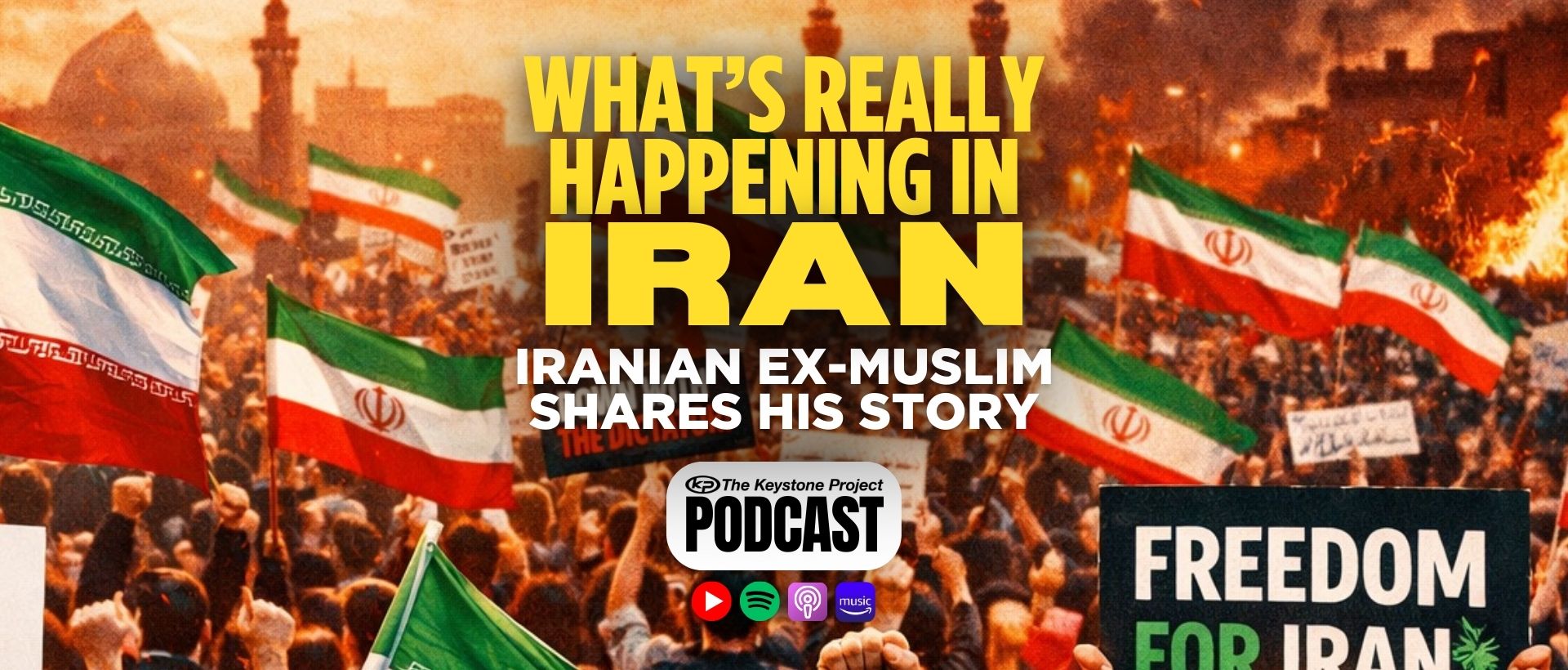
What’s Really Happening in Iran? A Spiritual Crisis Behind the Protests
When images of protests in Iran flash across our screens, most explanations stop at politics, economics, or foreign interference. But according to those who have lived under the Islamic Republic, something far deeper is unfolding.
Beneath the chants, the unrest, and the global headlines is a spiritual revolt—a rejection not only of a regime, but of a religious system many Iranians believe has crushed their souls.
In our latest episode of The Keystone Project Podcast, we sit down with Ramin Parsa, an Iranian ex-Muslim whose personal story offers rare and sobering insight into why millions of Iranians are turning away from Islam—and why many are becoming radically open to Jesus Christ.
Growing Up Under the Islamic Republic
Ramin was raised in Iran under the Shiite Islamic system that permeates every part of life. Since the Arab conquest of Persia in the 7th century—and especially following the 1979 Islamic Revolution—Islam has shaped education, law, media, culture, and identity in Iran.
From childhood, Ramin was taught to love Allah, observe Ramadan, attend mosque, and perform religious duties in hopes of earning righteousness and eventually entering heaven. Faith was not optional—it was enforced.
Yet despite deep devotion, something was missing.
Ramin recalls watching his mother and sisters pray for hours, weeping and begging at shrines—and receiving no answers. What should have brought peace instead produced emptiness.
Fear as a Tool of Faith
Ramin describes religious ceremonies involving self-flagellation, public rituals of mourning, and an atmosphere saturated with fear. Disobedience to Islamic law was met with punishment—sometimes brutal.
As a child, he witnessed public executions justified as defending Islam and the revolution. These scenes were not hidden; they were intentional, designed to teach fear.
One moment stands out: Ramin’s brother was arrested simply for unknowingly eating in public during Ramadan. This wasn’t about morality—it was about control.
At 16, Ramin himself was arrested at a Sharia checkpoint while traveling with relatives who had consumed alcohol. What followed was torture and humiliation: beatings with thick cables, forced physical exhaustion, overcrowded filthy cells, and constant mockery from guards.
This was religion enforced by violence.
Questioning Islam From the Inside
As Ramin grew older, he began to question what he had been taught. The word Islam means “submission” or “surrender”—but surrender to what?
His mother insisted Islam was good and blamed extremists for the brutality. So Ramin did what many Iranians are now doing: he read the Quran and Hadith for himself, in a language he could fully understand.
What he found deeply disturbed him.
Commands to kill unbelievers. Curses against Jews and Christians. The practice of jizya—a tax non-Muslims must pay to avoid death. Stories of Muhammad marked by violence, deception, and abuse of power.
The more Ramin read, the more the cruelty he experienced made sense. The problem wasn’t radicals—it was the system itself.
Jesus: The Great Contrast
At school, students were taught to hate Israel and America. Apocalyptic verses about killing Jews were recited casually. Yet when Ramin encountered the teachings of Jesus, the contrast was overwhelming.
Jesus spoke of love, forgiveness, mercy, and laying down one’s life for others. Islam’s founder and texts emphasized domination, fear, and force.
Ramin rejected Islam—but he didn’t immediately embrace Christianity. Instead, he entered a dark season of agnosticism, mourning the loss of his father and wrestling with the meaning of life amid injustice.
Alone in the darkness, he cried out to God: “If You are real, show Yourself to me.”
A Life-Changing Encounter
At 19, Ramin accidentally heard a Christian testimony on a banned foreign radio station. A man on the brink of suicide spoke of being transformed by Jesus. Something stirred.
After repeated encounters with Christian broadcasts, Ramin prayed a simple prayer, asking Jesus to reveal Himself.
What followed was instantaneous and overwhelming: joy, peace, love, forgiveness, and freedom unlike anything he had ever known. Burdens lifted. His heart changed. His life was transformed.
For the first time, prayer was answered.
Even more remarkable—his devout Muslim mother witnessed the change, experienced physical healing after Ramin prayed for her, and became the first in his family to follow Jesus.
A Nation in Spiritual Transition
Ramin’s story is not unique.
Across Iran, mosques are closing due to lack of attendance—an estimated 50,000 out of 75,000. Many Iranians are rejecting Islamic identity altogether, even changing their names from Islamic ones to ancient Persian names like Cyrusand Darius, reclaiming a pre-Islamic heritage.
Ramin later discovered that Cyrus the Great—celebrated in Persian history—was also God’s chosen instrument in Scripture, prophesied in Isaiah to free the Jewish people from exile.
This biblical history had been hidden from him his entire life.
The Underground Church Is Growing
After surviving persecution and a stabbing attack, Ramin fled Iran and eventually found refuge in Turkey, where he received a full Bible and joined a Christian community. From there, he began distributing Bibles to Iranians hungry for truth.
Later immigrating to the United States, Ramin helped plant a Persian church and witnessed hundreds come to faith and be baptized. He now lives in Israel, married to a Messianic Jewish believer, continuing outreach to Iranians and Arab Muslims alike.
He describes the underground church in Iran as pure, bold, prayerful, and deeply devoted to Jesus—not denominational, not institutional, but alive.
A Call to the Global Church
Ramin challenges believers in the West to wake up.
While Western Christianity often grows complacent, persecuted believers pray with urgency, read Scripture with hunger, and cling to Christ with everything they have.
He warns of Europe’s spiritual decline—where churches close and mosques rise—and urges American Christians not to repeat the same mistakes.
This is a moment.
A spiritual opening.
And a call to prayer, courage, and mission.
Watch the Full Conversation
This episode is not just a testimony—it’s a window into one of the most significant spiritual movements of our time.
🎧 Watch or listen to the full episode of The Keystone Project Podcast to hear Ramin Parsa’s story in his own words and understand what’s really happening in Iran.
Let us pray for the people of Iran, the underground church, and for boldness to join what God is doing among the nations.